
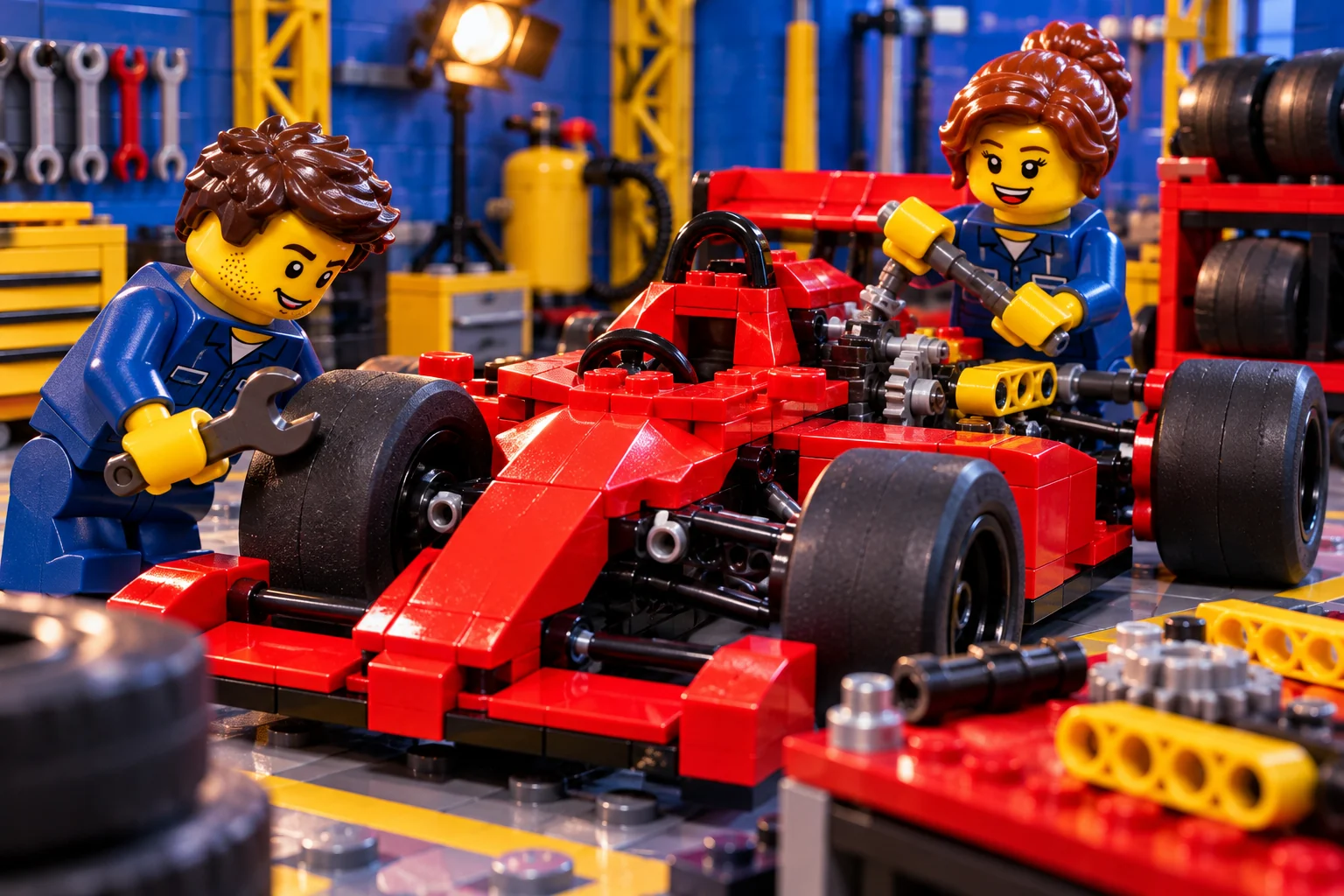
Build it where you can see it
Technic mechanisms are easier to understand before bodywork covers them. Mount two gears on separate, supported axles in a small frame. Turn one by hand and watch the other. Meshing gears rotate in opposite directions. Change one gear for a different size and count how many turns the small gear makes while the large one turns once. A larger gear driving a smaller one increases output speed while reducing available turning force; reverse them and the output slows while mechanical advantage rises. Real models also lose some force to friction.
Keep the axles parallel and the gears fully engaged without crushing them together. If the mechanism binds, disconnect the output and test each axle alone. Friction in a tight pin, a rubbing beam, or an unsupported long axle can masquerade as a gear problem. Diagnose one source of resistance at a time. A hand-powered trial is safer for the model than adding a motor to a jammed assembly.
Add a purposeful output
Connect the output axle to something visible: a turntable, a small fan, or a crank that lifts a light lever. Now the gear ratio has a job. Choose faster motion for a spinner and slower, stronger motion for a lifting demonstration. If the load stalls, do not assume you only need another gear. Check the load path, the alignment, and whether the frame flexes. Bracing the axle supports may fix more than changing the ratio.
LEGO Education materials use gear arrangements to teach speed, force, and differential behavior. Their diagrams are a useful companion to physical trial, but your fingers remain the best early sensor. Turn the mechanism through a full cycle and feel for a repeating snag that might be hidden at only one point of rotation.
Record what changed
Photograph each version before taking it apart. Note the gear sizes, which axle you turned, how many output turns you observed, and where resistance appeared. That little record turns play into a reusable technique. When you later build a vehicle or animated display, you can choose a ratio for a reason instead of guessing from the color of the gears.
The point of a first mechanism is clarity. Leave the gears exposed until you understand their behavior, then build the body around a working system. A model that moves reliably is more satisfying than one whose hidden motor makes a noise but no visible action.